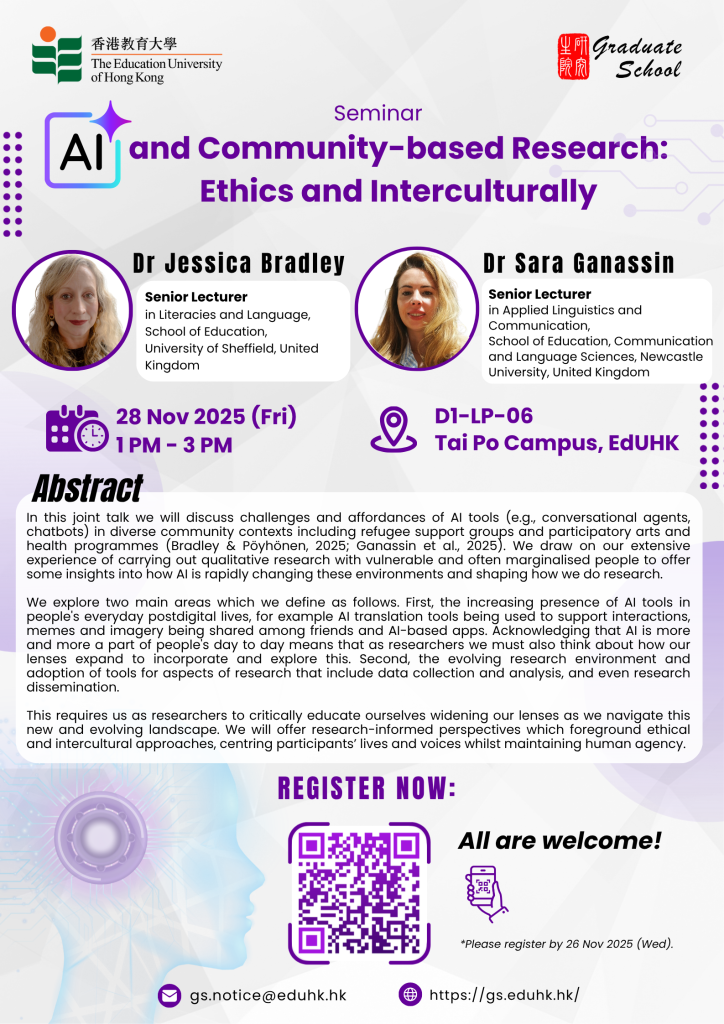

[28 Nov Seminar] AI and Community-based Research: Ethics and Interculturally
Dear Colleagues and Students,
You are cordially invited to attend the seminar on AI and Community-based Research: Ethics and Interculturally, organised by the Graduate School (GS).
Details are as follows:
| Date | 28 November 2025 (Friday) |
| Time | 1:00 PM – 3:00 PM |
| Venue | D1-LP-06, Tai Po Campus, EdUHK |
| Speakers | Dr Jessica Bradley Senior Lecturer in Literacies and Language, School of Education, The University of Sheffield, UK Dr Sara Ganassin Senior Lecturer in Applied Linguistics and Communication, School of Education, Communication and Language Sciences, Newcastle University, UK |
| Registration | Register HERE *Please register by 26 November 2025 (Wednesday). |
About Speakers
Dr Jessica Bradley is a Senior Lecturer in Literacies and Language, in the School of Education at the University of Sheffield (UK). She is known for her research in applied linguistics and the arts, and she has conducted research with diverse communities, including creative practitioners and health-care professionals.
Dr Sara Ganassin is a Senior Lecturer in Applied Linguistics and Communication at the School of Education, Communication and Language Sciences, Newcastle University (UK). Her research interests include migrant and refugee communities; Chinese heritage language learning and teaching; and ethics and reflexivity in research with vulnerable groups.
Abstract:
In this joint talk we will discuss challenges and affordances of AI tools (e.g., conversational agents, chatbots) in diverse community contexts including refugee support groups and participatory arts and health programmes (Bradley & Pöyhönen, 2025; Ganassin et al., 2025). We draw on our extensive experience of carrying out qualitative research with vulnerable and often marginalised people to offer some insights into how AI is rapidly changing these environments and shaping how we do research.
We explore two main areas which we define as follows. First, the increasing presence of AI tools in people’s everyday postdigital lives, for example AI translation tools being used to support interactions, memes and imagery being shared among friends and AI-based apps. Acknowledging that AI is more and more a part of people’s day to day means that as researchers we must also think about how our lenses expand to incorporate and explore this. Second, the evolving research environment and adoption of tools for aspects of research that include data collection and analysis, and even research dissemination.
This requires us as researchers to critically educate ourselves widening our lenses as we navigate this new and evolving landscape. We will offer research-informed perspectives which foreground ethical and intercultural approaches, centring participants’ lives and voices whilst maintaining human agency.
We look forward to seeing you there!
All are welcome.
Best regards,
Graduate School