Seminars on Eco-pedagogy, Crisis, and AI in Education
Dear students,
You are cordially invited to a series of seminars delivered by cutting‑edge scholars and educators from the Western Norway University of Applied Sciences (HVL) as part of the Global Competence Partnership project.
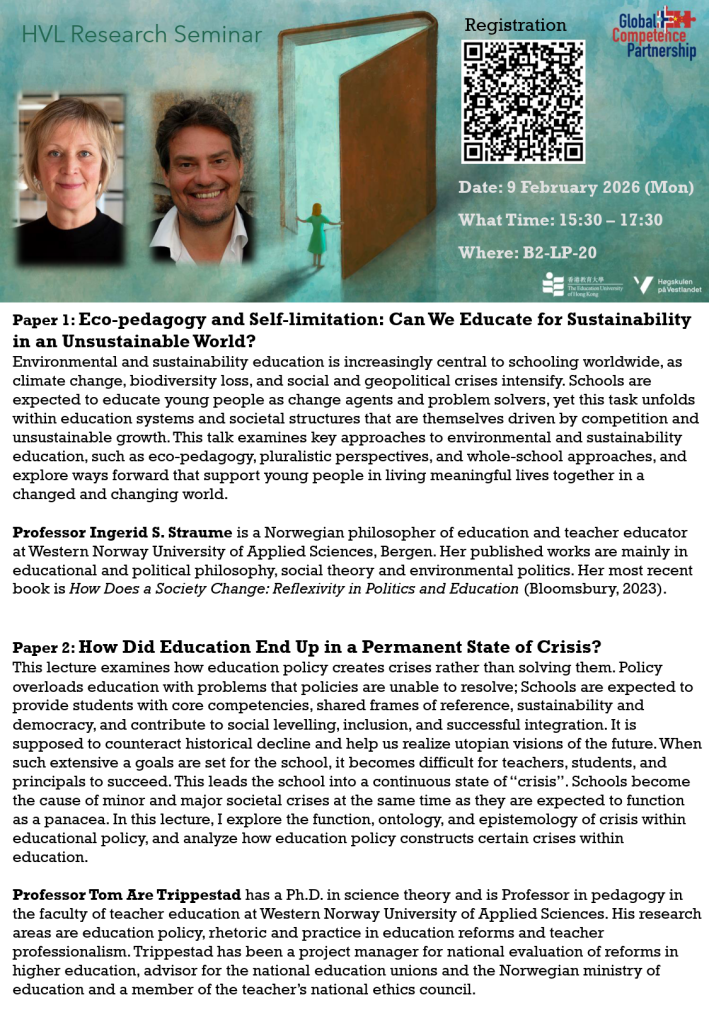
Seminar 1 (Two Presentations)
| Speakers & Titles | 1. Prof Ingerid Straume Eco-pedagogy and Self-limitation: Can We Educate for Sustainability in an Unsustainable World? 2. Prof Tom Are Trippestad How Did Education End Up in a Permanent State of Crisis? |
| Date | 09 February 2026 (Monday) |
| Time | 3:30 pm – 5:30 pm |
| Venue | B2-LP-20, Tai Po Campus |
| Registration | https://forms.office.com/r/xd0girDpaM |
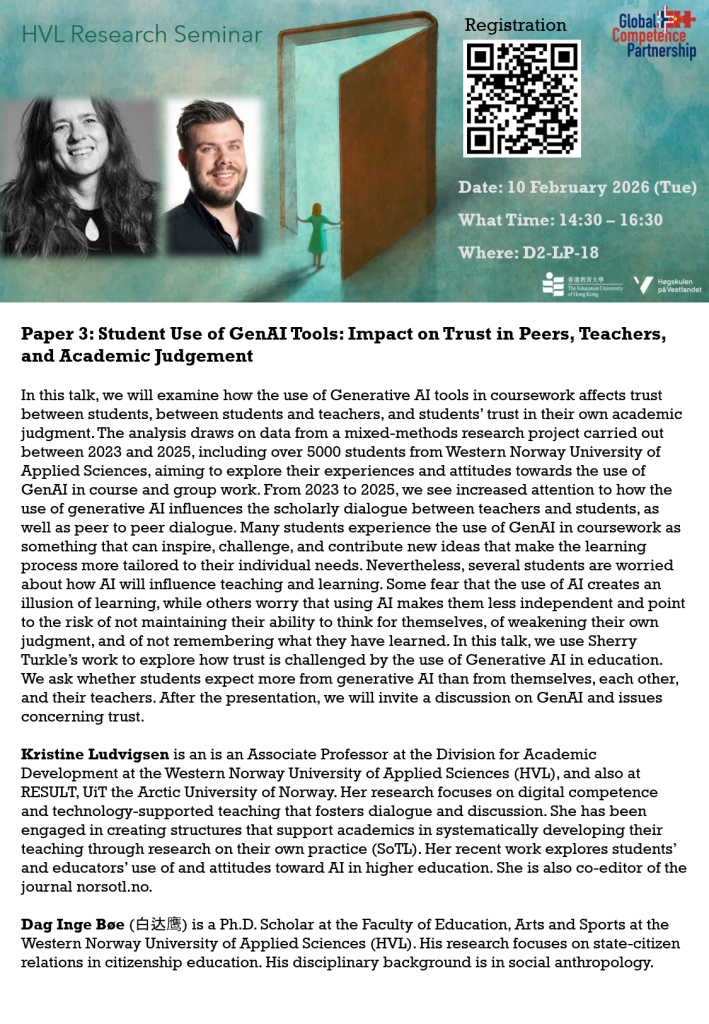
Seminar 2 (Co-presentation)
| Speakers & Title | 3. Prof Kristine Ludvigsen & Dag Inge Bøe Student Use of GenAI Tools: Impact on Trust in Peers, Teachers, and Academic Judgement |
| Date | 10 February 2026 (Tuesday) |
| Time | 2:30 pm – 4:30 pm |
| Venue | D2-LP-18, Tai Po Campus |
| Registration | https://forms.office.com/r/XKDbMpZE3s |
Paper 1: Eco-pedagogy and Self-limitation: Can We Educate for Sustainability in an Unsustainable World?
Environmental and sustainability education is increasingly central to schooling worldwide, as climate change, biodiversity loss, and social and geopolitical crises intensify. Schools are expected to educate young people as change agents and problem solvers, yet this task unfolds within education systems and societal structures that are themselves driven by competition and unsustainable growth. This talk examines key approaches to environmental and sustainability education, such as eco‑pedagogy, pluralistic perspectives, and whole‑school approaches, and explore ways forward that support young people in living meaningful lives together in a changed and changing world.
Professor Ingerid S. Straume is a Norwegian philosopher of education and teacher educator at Western Norway University of Applied Sciences, Bergen. Her published works are mainly in educational and political philosophy, social theory and environmental politics. Her most recent book is How Does a Society Change: Reflexivity in Politics and Education (Bloomsbury, 2023).
Paper 2: How Did Education End up in a Permanent State of Crisis?
This lecture examines how education policy creates crises rather than solving them. Policy overloads education with problems that policies are unable to resolve; Schools are expected to provide students with core competencies, shared frames of reference, sustainability and democracy, and contribute to social levelling, inclusion, and successful integration. It is supposed to counteract historical decline and help us realize utopian visions of the future. When such extensive a goals are set for the school, it becomes difficult for teachers, students, and principals to succeed. This leads the school into a continuous state of “crisis”. Schools become the cause of minor and major societal crises at the same time as they are expected to function as a panacea. In this lecture, I explore the function, ontology, and epistemology of crisis within educational policy, and analyze how education policy constructs certain crises within education.
Professor Tom Are Trippestad has a Ph.D. in science theory and is Professor in pedagogy in the faculty of teacher education at Western Norway University of Applied Sciences. His research areas are education policy, rhetoric and practice in education reforms and teacher professionalism. Trippestad has been a project manager for national evaluation of reforms in higher education, advisor for the national education unions and the Norwegian ministry of education and a member of the teacher’s national ethics council.
Paper 3: Student Use of GenAI Tools: Impact on Trust in Peers, Teachers, and Academic Judgement
In this talk, we will examine how the use of Generative AI tools in coursework affects trust between students, between students and teachers, and students’ trust in their own academic judgment. The analysis draws on data from a mixed-methods research project carried out between 2023 and 2025, including over 5000 students from Western Norway University of Applied Sciences, aiming to explore their experiences and attitudes towards the use of GenAI in course and group work. From 2023 to 2025, we see increased attention to how the use of generative AI influences the scholarly dialogue between teachers and students, as well as peer‑to‑peer dialogue. Many students experience the use of GenAI in coursework as something that can inspire, challenge, and contribute new ideas that make the learning process more tailored to their individual needs. Nevertheless, several students are worried about how AI will influence teaching and learning. Some fear that the use of AI creates an illusion of learning, while others worry that using AI makes them less independent and point to the risk of not maintaining their ability to think for themselves, of weakening their own judgment, and of not remembering what they have learned. In this talk, we use Sherry Turkle’s work to explore how trust is challenged by the use of Generative AI in education. We ask whether students expect more from generative AI than from themselves, each other, and their teachers. After the presentation, we will invite a discussion on GenAI and issues concerning trust.
Professor Kristine Ludvigsen is an is an Associate Professor at the Division for Academic Development at the Western Norway University of Applied Sciences (HVL), and also at RESULT, UiT the Arctic University of Norway. Her research focuses on digital competence and technology-supported teaching that fosters dialogue and discussion. She has been engaged in creating structures that support academics in systematically developing their teaching through research on their own practice (SoTL). Her recent work explores students’ and educators’ use of and attitudes toward AI in higher education. She is also co-editor of the journal norsotl.no.
Dag Inge Bøe (白达鹰) is a Ph.D. Scholar at the Faculty of Education, Arts and Sports at the Western Norway University of Applied Sciences (HVL). His research focuses on state-citizen relations in citizenship education. His disciplinary background is in social anthropology.
* This event is part of the Global Competence Partnership project led by Dr Koji Matsunobu (CCA) at EdUHK and Prof David Hebert at the Western Norway University of Applied Sciences (https://www.hvl.no/en/collaboration/project/global-competence-partnership/).
We look forward to seeing you at the seminar.
Best regards,
Graduate School